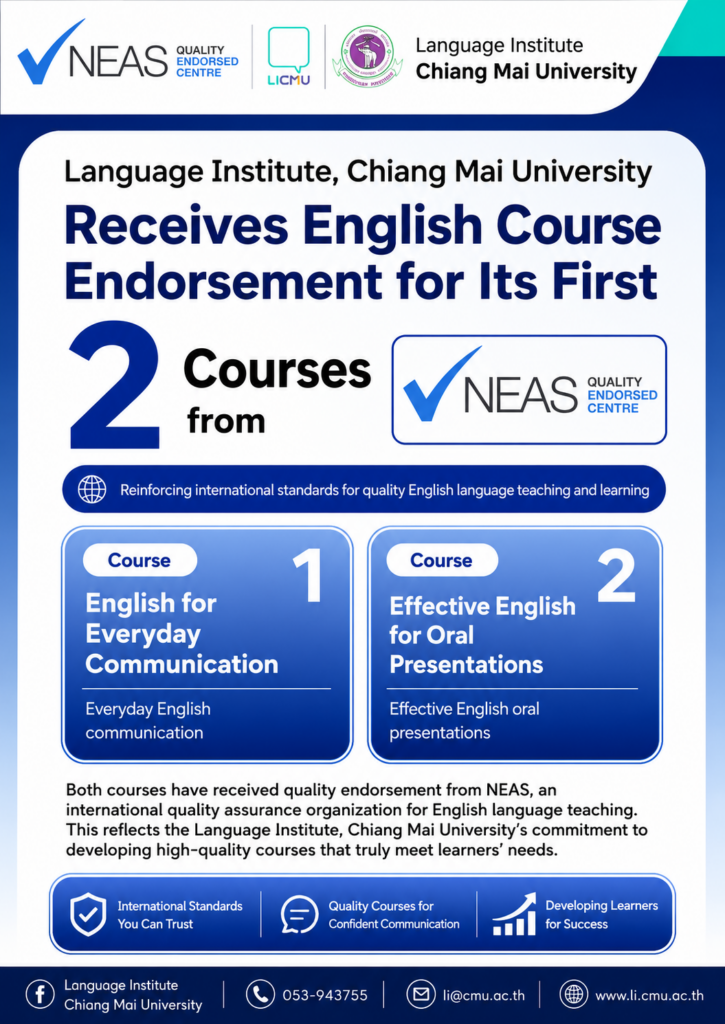


The Language Institute, Chiang Mai University (CMU), has successfully obtained accreditation from NEAS (National ELT Accreditation Scheme) for two of its English language programs. This achievement marks a significant milestone in the Institute’s ongoing efforts to elevate the quality of its English language education to align with international standards and meet learners’ needs in real-world communication contexts.
The two accredited programs are:
- English for Everyday Communication
This course is designed for beginner to lower-intermediate learners who wish to improve their English communication skills for real-life situations. The program focuses on developing listening and speaking skills, building confidence in communication, and enabling learners to use English appropriately in everyday, social, and workplace contexts.
- Effective English for Oral Presentations
This course is intended for learners who want to enhance their English presentation skills. It emphasizes presentation organization, audience engagement, clear and effective language use, confident delivery, and the effective use of presentation aids. The program is particularly suitable for students, university staff, and professionals who need to deliver academic or workplace presentations in English.
Receiving NEAS accreditation reflects the Language Institute’s strong commitment to delivering high-quality English language programs. The accreditation recognizes the Institute’s focus on learner-centered course design, clearly defined learning outcomes, effective teaching and learning processes, authentic language assessment, and continuous program improvement.
Furthermore, this accreditation strengthens the confidence of learners, partner organizations, and stakeholders both in Thailand and internationally, affirming that the CMU Language Institute has the capability to provide English language education that meets internationally recognized quality standards.
The Language Institute, Chiang Mai University, remains committed to continuously enhancing its programs, teaching practices, and quality assurance systems to help learners develop confidence and proficiency in English, preparing them for further study, professional success, and effective communication in global contexts.